
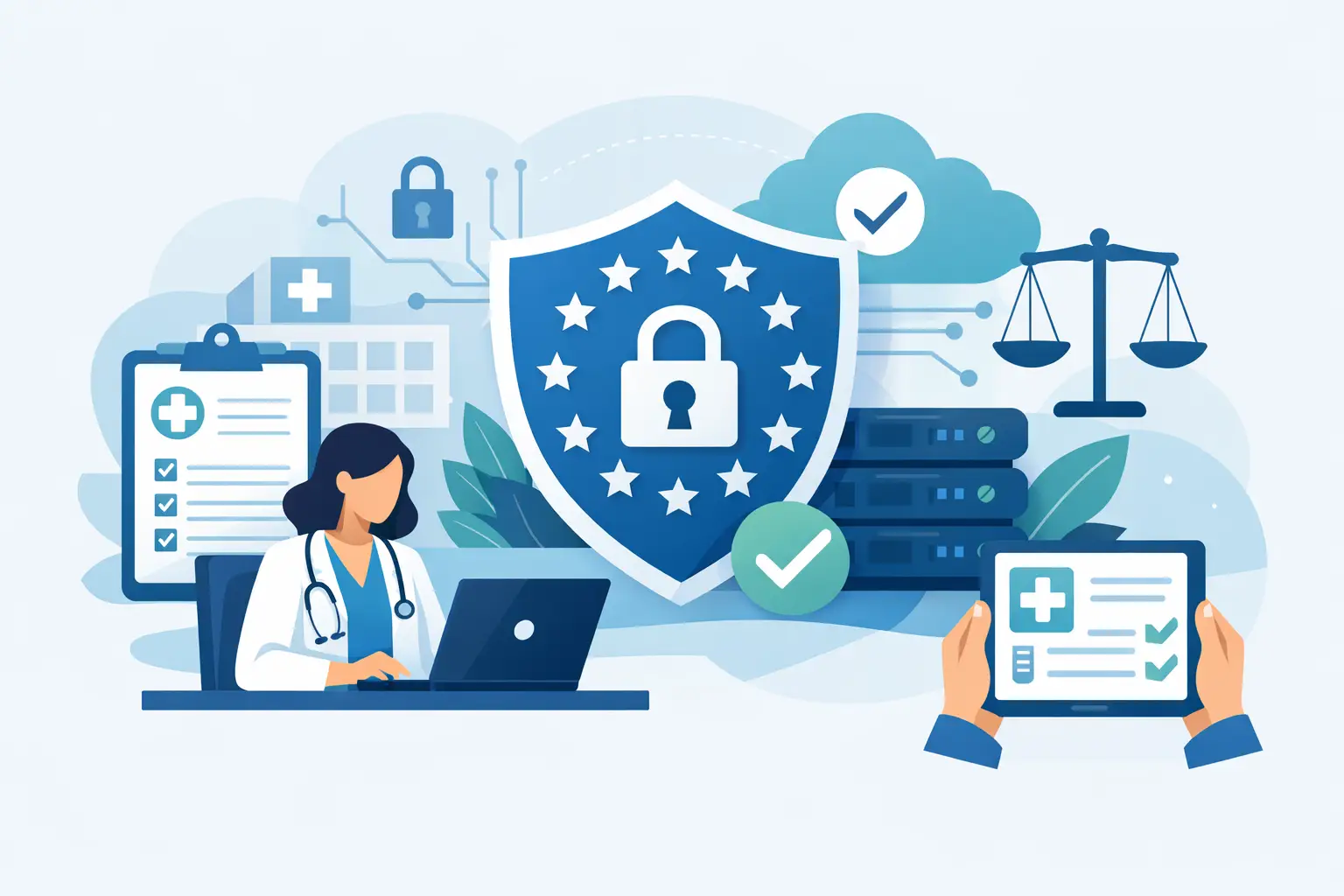
A patient asks for a copy of their records, a practitioner updates notes from home, and your reception team confirms tomorrow's bookings across two locations. If those actions sit across separate tools, spreadsheets, and inboxes, GDPR compliant clinic software stops being a legal checkbox and becomes an operational requirement.
For clinic owners and operations managers, GDPR is not just about where data is stored. It affects who can access it, how quickly you can respond to requests, whether consent is recorded properly, and how confidently your team handles personal information every day. The right system reduces risk by making compliant processes part of normal clinic administration rather than an extra burden.
What GDPR compliant clinic software actually needs to do
Many platforms claim to support compliance, but the standard should be higher than a privacy statement and password protection. GDPR compliant clinic software should help your clinic control personal data throughout its lifecycle, from initial booking through treatment, billing, follow-up communication, and eventual deletion or retention review.
That means the software needs to support lawful data handling in practical terms. Your team should be able to limit access by role, record consent clearly, track changes to records, and retrieve patient information without relying on manual workarounds. If a subject access request arrives, the system should help you fulfil it efficiently. If a staff member leaves, access should be removed immediately without creating operational gaps.
A clinic platform also needs to reflect the reality of healthcare administration. Patient communications, invoices, clinical notes, practitioner diaries, intake forms, and reporting often sit in the same operational environment. Compliance breaks down when these functions are fragmented. One system may handle scheduling, another billing, and a third messaging tool may hold sensitive details with weaker oversight. That structure creates risk because policies become harder to enforce consistently.
Why fragmented systems create GDPR problems
The biggest compliance issues in clinics rarely begin with malicious intent. They usually start with messy processes. A receptionist exports appointments into a spreadsheet to manage follow-ups. A practitioner stores notes locally to save time. A manager uses separate tools to compare performance across sites. Each step may feel minor, but together they create duplicated data, inconsistent permissions, and poor visibility over who holds what.
This is where GDPR compliant clinic software has a direct operational benefit. When booking, patient records, billing, communications, and reporting are centralised, your clinic has a clearer chain of control. Staff work in one governed environment rather than moving data between disconnected systems. That reduces the chance of error and makes training easier because processes are standardised.
For multi-location organisations, this matters even more. Different sites often develop their own admin habits over time. Without central controls, one location may be stricter than another in how it captures consent or manages record access. A platform that supports system-wide configuration helps leadership apply the same rules across the business while still giving each clinic the tools it needs to operate efficiently.
The features that matter most
Access control is one of the clearest signals of whether a platform is suitable. Not every team member should see every piece of patient information. Reception staff may need booking details and contact history, while practitioners need clinical records relevant to care delivery. Finance teams may require invoice visibility without unrestricted access to notes. If permissions are too broad, risk increases. If they are too rigid, staff create workarounds.
Audit trails are equally important. Clinics need to know who viewed, edited, exported, or deleted data and when it happened. This is useful for compliance, but it is also valuable for day-to-day accountability. When information changes unexpectedly, an audit trail helps managers resolve issues quickly.
Consent management should also be built into normal workflows. Clinics need a reliable way to capture and store patient consent for communications, marketing where applicable, and specific forms of data use. Consent should not live in handwritten notes or disconnected forms that are hard to retrieve later.
Secure patient communication matters as well. Appointment reminders, intake requests, and follow-up messages improve attendance and reduce admin time, but they must be handled with care. The system should support communication processes that are practical for staff and respectful of patient privacy. Convenience matters, but not at the expense of control.
Then there is reporting. Many clinics focus on security features alone and overlook reporting as a compliance tool. Good reporting helps you monitor access patterns, identify operational inconsistencies, and maintain visibility across teams and locations. It also supports better decision-making without forcing managers to extract data into unmanaged files.
GDPR compliant clinic software for growing practices
Small clinics can often manage around weak systems for a while. Growth changes that quickly. More practitioners, more locations, and more appointment volume increase the number of people handling personal data and the number of points where errors can happen.
A growing practice needs more than basic appointment software with a few privacy settings. It needs structure. That includes central administration, consistent user permissions, standardised workflows, and reporting that gives leadership visibility across the organisation. Software that works for a single diary and one receptionist may fail once you are coordinating rotas, billing, communications, and performance across multiple sites.
This is why software selection should be led by operations, not only by front-desk convenience or headline price. A cheaper system can become expensive if it creates admin duplication, weakens compliance controls, or limits your ability to scale. GDPR compliance and operational control are closely linked. When processes are disciplined, compliance becomes easier to maintain.
Questions to ask before you choose a platform
The right vendor should be able to answer detailed questions clearly. Ask how user permissions are structured, how patient data is stored and accessed, what audit capabilities are available, and how the platform supports subject access requests and data retention processes. If the answers stay vague, that is a warning sign.
You should also ask how the software handles multi-site administration. Can head office applyconsistent settings across locations? Can reporting be segmented by clinic, practitioner, or service while still maintaining central oversight? Can staff access be controlled by role and site? These are practical governance questions, not just technical ones.
It is also worth looking at how the system reduces manual handling. The more your team relies on exports, duplicate entry, and off-system communication, the harder it is to maintain compliance. Software should remove those gaps, not create new ones.
For many healthcare businesses, an all-in-one platform is the stronger option because it keeps core operational functions under one set of controls. Wellspring Scheduling is built around that model, giving clinics one environment for bookings, staff scheduling, billing, patient management, communications, and reporting. That matters because compliance is easier to manage when the business is not stitching together separate tools.
Compliance should support better operations
There is a tendency to treat GDPR as a brake on efficiency. In practice, poor systems are usually the real problem. When software supports clear permissions, reliable records, automated communication, and central oversight, your team spends less time chasing information and more time delivering care.
Patients notice the difference as well. They may not ask about your data architecture, but they will notice when forms are handled properly, communication is timely, and their information does not need to be repeated at every touchpoint. Trust is built through competent administration as much as clinical quality.
That is the real value of GDPR compliant clinic software. It protects sensitive information, but it also gives your clinic a stronger operating model - one that is easier to manage, easier to scale, and easier to govern. If your current setup depends on disconnected systems and manual fixes, compliance risk is only one reason to change. The bigger reason is that your clinic will run better when control is built into the platform from the start.
Before choosing your next system, look past feature lists and ask a simpler question: does this software help us run a tighter, safer, more accountable clinic every day?