
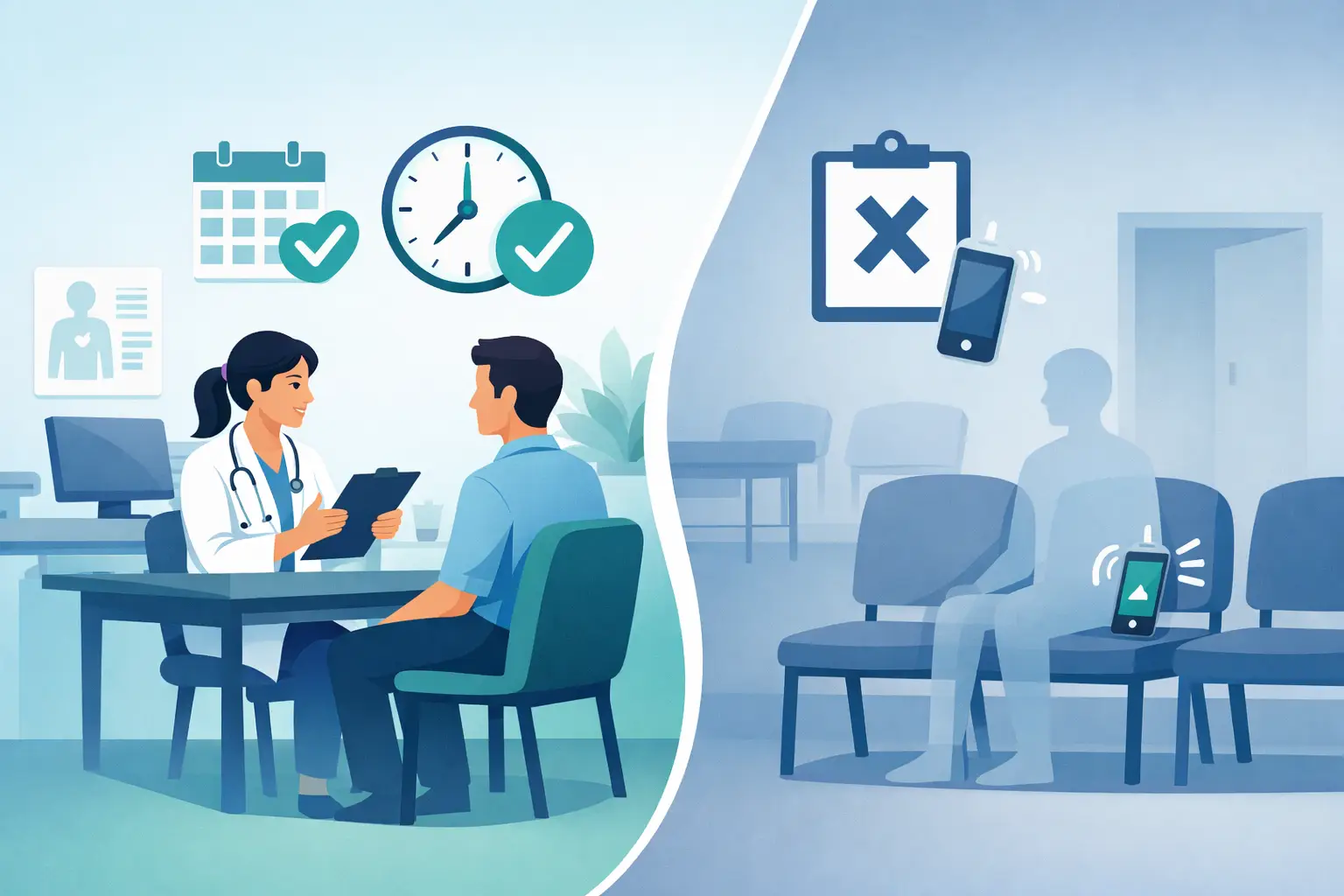
A full clinic diary looks healthy until ten minutes past the hour, when two patients have not arrived, one has not answered the phone, and a clinician is left with a gap that cannot be billed. That is why healthcare leaders keep asking how to reduce no shows in clinic settings without adding more admin work or creating friction for patients.
The answer is rarely one tactic. No-shows usually come from a mix of weak booking controls, poor reminder timing, limited patient accountability, and fragmented follow-up. If your practice runs across multiple practitioners or locations, the problem compounds quickly. The right approach is operational: standardise the booking journey, automate communication, and track the causes closely enough to improve them.
Why no-shows happen more often than clinics expect
Most missed appointments are not random. Patients miss bookings because they forgot, booked too far ahead, were unclear on the time or location, could not easily confirm or reschedule, or never felt fully committed in the first place. Some appointment types also carry higher risk. Initial consultations, lower-cost sessions, recurring wellness appointments, and bookings made online without staff intervention often need tighter confirmation processes.
Operational inconsistency is another common cause. One site sends reminders 48 hours in advance, another sends them the morning of the appointment, and a third relies on manual calls when the reception team has time. That kind of variation makes no-show rates harder to control. If you want predictable attendance, patients need a predictable communication process.
How to reduce no shows in clinic with better booking controls
The earliest point of prevention is at the time of booking. Clinics often focus on reminders later, but weak booking processes create attendance problems from the start.
First, reduce ambiguity. Every appointment confirmation should clearly state the date, time, practitioner, location, and expected duration. If the patient has booked into a class, group session, or specialist service, the communication should also explain arrival instructions and any preparation required. Confusion drives avoidable absence.
Second, make commitment part of the booking process. For some clinics, that means taking a deposit. For others, it means storing a payment method, requiring acceptance of a cancellation policy, or asking patients to actively confirm rather than passively receive an appointment notice. The right model depends on your service type and patient base. A counselling clinic may need a more sensitive policy than a high-volume physio practice, but both still benefit from clear expectations.
Third, avoid excessive lead times where possible. The further out an appointment sits, the more likely life gets in the way. If demand allows, reserve some diary capacity for shorter-term booking windows. This is especially useful for follow-up appointments, where patients are more likely to attend if the session feels immediate and relevant.
Reminder workflows need structure, not guesswork
Reminder messages work, but only when they are consistent and timed properly. Sending one generic text the day before is better than nothing, yet it will not solve the underlying issue if patients have no easy way to respond.
A stronger process usually includes a confirmation at the point of booking, a reminder several days before the appointment, and a final same-day message where appropriate. High-value or high-risk appointments may justify an additional prompt or manual outreach. The key is not volume. It is sequencing.
Patients should be able to confirm, cancel, or request a change without needing to call during reception hours. If the only route to reschedule is a phone queue, some patients will simply not attend. Automated two-way communication and online self-service reduce that friction and return unused time to the diary sooner.
For multi-site organisations, reminder rules should be centrally managed. That keeps messaging consistent across locations, practitioners, and appointment types. It also protects performance when staff change or individual sites develop their own workarounds.
Your cancellation policy matters, but only if it is enforceable
Many clinics have a cancellation policy that exists on paper and nowhere else. Patients agree to it once, staff apply it inconsistently, and no one is quite sure when to waive a fee. That creates uncertainty internally and weakens accountability externally.
An effective policy is clear, proportionate, and built into the system. Patients should see it at booking and in confirmations. Staff should follow a standard process. Charges, deposits, or late cancellation rules should be linked to the appointment record so they can be applied consistently and reported properly.
There is a balance to strike. A policy that is too rigid can frustrate good patients, especially in services where health conditions can change quickly. A policy that is too loose teaches patients that the appointment slot has little value. Most clinics need enough flexibility for genuine exceptions, alongside firm operational rules for repeat no-shows and late cancellations.
Use data to identify where no-shows are really coming from
If your team is still discussing no-shows in general terms, it is difficult to fix them. You need visibility by location, practitioner, service, time of day, referral source, and patient type.
Patterns usually appear quickly. You may find that one clinic site has a much higher no-show rate on evening appointments, or that first-time online bookings miss more often than returning patients booked by reception. You may also find that certain practitioners have lower no-show rates because they set expectations more clearly during the initial interaction.
This is where centralised reporting becomes operationally valuable. Instead of relying on anecdotal feedback from front desk staff, you can monitor attendance trends across the business and adjust workflows based on evidence. Wellspring Scheduling supports this kind of control by bringing booking, communications, and reporting into one system, which makes it easier to spot attendance risks before they become a wider revenue issue.
Staff training still plays a direct role
Automation helps, but staff behaviour still shapes patient attendance. Reception teams and practitioners influence whether an appointment feels fixed, optional, urgent, or easy to postpone.
At the point of booking, staff should confirm key details verbally, restate cancellation expectations, and explain the next step. During treatment, practitioners should reinforce the reason for follow-up and the importance of attending at the agreed interval. This is particularly important in allied health and wellness services, where patients may see appointments as beneficial but not essential.
Consistency matters here as much as tone. If one team member says, "Let us know if anything changes," and another says, "Please give us 24 hours' notice as this time is reserved for your care," the patient receives different signals about commitment.
Fill gaps faster when cancellations do happen
Even well-run clinics will still have some cancellations and no-shows. The operational goal is to reduce wasted capacity when they happen.
A live waitlist or short-notice contact list can help backfill released appointments quickly. This works especially well for busy services with limited availability, where patients are willing to attend at short notice. Online booking also helps here, because newly freed slots can become visible immediately rather than waiting for a staff member to update the diary manually.
Not every clinic needs the same gap-filling process. A multi-practitioner physio business may benefit from centralised waitlist management across locations, while a counselling practice may need more controlled matching between patient and clinician. The principle is the same: unused time should return to bookable inventory as quickly as possible.
Reduce no-shows by making the patient journey easier
Patients are more likely to attend when the process feels straightforward. Friction creates drop-off.
That includes simple online booking, clear confirmations, mobile-friendly reminders, accurate location details, and straightforward payment processes. It also includes making sure duplicate records, double bookings, and unclear service names do not confuse the patient before they arrive.
This is often where disconnected systems cause hidden problems. If scheduling, billing, communications, and patient records sit in separate tools, staff spend more time reconciling errors and less time proactively managing attendance. An integrated clinic management platform reduces those handoffs and gives teams a cleaner operational process from booking to payment.
The most effective strategy is standardised and measurable
If you want to know how to reduce no shows in clinic operations over the long term, treat attendance as a system metric, not a front desk problem. Set booking rules. Automate reminders. Apply policy consistently. Review no-show data monthly. Adjust by service line and location where needed.
The payoff is bigger than diary protection. Lower no-show rates improve clinician utilisation, reduce wasted payroll time, strengthen billing predictability, and create a better patient experience because appointments are easier to manage. For growing healthcare organisations, that level of control matters.
A missed appointment is not always preventable. Repeated missed appointments usually are. The clinics that improve attendance are the ones that stop relying on memory, goodwill, and manual chasing, and start building a process that works the same way every time.